Monthly Archives: February 2025
Yet Another Focaccia, Starring Sourdough Discard

I’ve mentioned before, and posted recipes for, sourdough bread, using my wonderful aged and active San Francisco-born starter. I keep my starter small, to reduce the amount of discard (having worked in a large commercial production kitchen, I hate discarding ANYTHING!). My starter regimen is this: from my daily starter feeding, I retain 5 grams of starter, add 20 grams whole-wheat flour, and 20 grams of spring water, and save the remaining starter in a 1-pint Mason jar. When I have about 200 grams of discard I make something with it, like lemon and olive oil quick bread, zucchini-and-carrot quick bread, banana bread, or my favorite, herb-and-garlic focaccia. Adding the discard to my focaccia recipe produces an incredible extra layer of flavor that sings, and it keeps me from wasting beautiful ingredients. In addition, making foccacia allows me to experiment with flavor combinations using other concoctions I make myself, such as garlic-infused olive oil, lemon-and-fennel coarse salt, tomato sauce, jalapeno relish, pickled red onions, and home-grown pepperoncini peppers.
But here’s the basic focaccia platform, based on a recipe from Grace in My Space, which has become one of my go-to sources of all things sourdough.
INGREDIENTS:
- 170 grams sourdough discard (preferably fed at some point in the last 72 hours)
- 284 grams lukewarm water (90-105 degrees F)
- 1 tsp instant yeast
- 225 grams high-protein bread flour
- 280 grams all-purpose unbleached flour
- 2 tsp fine pink Himalayan or sea salt
PREPARATION:
- Begin by dissolving 170 grams of sourdough discard in 284 grams of warm water in a mixing bowl. Mix in 1 tsp of instant yeast and let sit for 10-15 minutes to let the yeast bloom.
- Add 225 grams of bread flour (spooned) and 280 grams unbleached all-purpose flour. Turn your mixer onto level 1 and mix ingredients with a dough hook attachment. Once the water-and-flour mixture is combined, add 2 tsp (11 grams) fine salt and continue mixing on level 3-4 until the dough is smooth and pulling away from the sides of the mixing bowl (the amount of time you allow your dough to mix will depend on your mixer, starter hydration, and temperature. Start with 4-5 minutes and then check your dough. When it is ready, it will not be too sticky to the touch and will stretch easily.
- Cover your mixed dough with plastic wrap and let it rise for 1-2 hours until it has doubled in size. I do this in the oven with the light turned on.
- Once your dough has doubled in size, line a 9×13 pan with parchment paper. Drizzle 2 tbs. of high-quality extra-virgin olive oil in the bottom of the lined pan and spread with a basting brush.
- Dump your dough into the oiled pan, allow it to rest for 10 minutes, and use your fingers to spread it evenly to all four corners of the baking pan. Add 2-3 more tablespoons of olive oil to the top of the dough.
- Then, add your fresh herbs and lightly dimple the dough further with wet fingertips to push the herbs into the dough.
- Once the herbs are added, cover the pan with plastic wrap and let rise another 1 hour.
- When the dough has completed its second rise, top with flaky salt, red onion, and minced garlic. Preheat the oven to 500 degrees Fahrenheit and bake for 15 minutes.
- After 15 minutes, lower the temperature to 450 degrees and rotate the pan 180 degrees, to help it bake evenly. Bake at 450 for 7-12 more minutes, until the top of the dough is nicely browned.
- Remove the focaccia from the oven and allow to cool on a wire rack before slicing.
TOPPINGS:
- 5 tbs high-quality olive oil, divided
- Flaky sea salt (I use Maldon salt, sometimes the smoked variety)
- 1/8 of a red onion, sliced thin lengthwise
- 3 cloves minced garlic
- 3 sprigs chopped fresh thyme (1 tsp dried thyme alternative)
- 2 sprigs chopped fresh oregano (1 tsp dried oregano alternative)
- 1 sprig fresh rosemary, coarsely chopped (or not!)
NOTES: Some alternative foccacia toppings, or use your imagination for others.
- Freshly harvested home-grown rosemary and garlic, using garlic-infused olive oil
- Butter, cinnamon, brown sugar, and raisins (often soaked in rum or brandy), and glazed with a milk-and-10X sugar glaze
- Kalamata olives, cherry tomato halves, and rosemary
- Freshly made tomato sauce, mozzarella, oregano, and assorted pizza toppings of your choice
Turmeric Chicken Stew
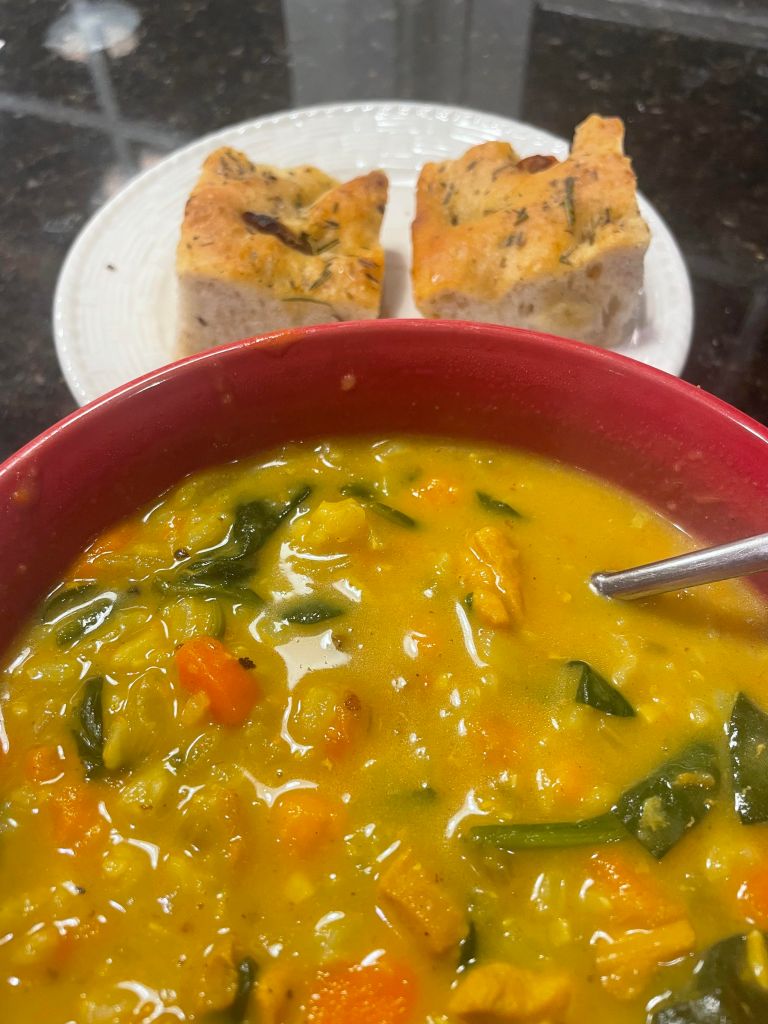
There’s not much better than a big, warm bowl of stew on a cold and snowy February evening. The good news is, my sweet partner has conjured up such a treat, which I have just feasted on as I watch the snow sprinkle down on my driveway. It’s thick and hardy and filled with the goodness from the produce department–Sweet potatoes, carrots, onions, spinach, and maybe tomorrow, peas. Yum!
On a cold, gray day this one’s bright yellow and dotted with green and orange, steaming hot and as tasty as I could possibly hope for. And all warmed by a wonderful combination of herbs and spices that just sing together like the birds we hope will survive this cold snap and grace our feeders in the next few days, after the piles of snow have been cleared. Alas, the Punxatawney groundhog promised this weather, and more on the way. Who knew?
So I’ll get right to the recipe, so you can read and imagine this bowlful of sunshine on a cloudy day. Here’s the roadmap…
Ingredients:
2 Tablespoons olive oil
1 1/2 pounds boneless, skinless chicken thighs, cut to 1-inch pieces
1 medium onion, diced
2 carrots, diced
1 stalk celery, diced
4 cloves garlic, minced
1-inch piece fresh ginger, peeled and minced
2 teaspoons ground turmeric or 2-inch piece of turmeric root, peeled and minced
1/2 teaspoon ground cumin
1/2 teaspoon ground coriander
1 teaspoon kosher salt, plus more to taste
1/2 teaspoon coarsely ground black pepper, plus more to taste
2 Tablespoons all-purpose flour
2 medium sweet potatoes, peeled and cubed, 1/2-inch cube
2 1/2 cups chicken broth
1/2 cup unsweetened coconut milk
3 cups fresh spinach, roughly chopped
1-2 cups cooked brown rice or barley (optional)
fresh cilantro, chopped, to garnish
Preparation:
- Dice chicken thighs and season generously with salt and black pepper.
- In a large pot preheated to medium-high, warm the olive oil and add the chicken, stirring constantly to brown on all sides (work in batches if necessary). Remove to a bowl and set aside.
- In the same pot, reduce heat to medium and add the onion, carrots, and celery, and cook 3-4 minutes, until the vegetables are just tender.
- Add the garlic, ginger, turmeric, cumin, coriander, salt, and pepper and cook for an additional 1-2 minutes, until the pot is fragrant.
- Return the chicken to the pot, sprinkle with flour, and stir vigorously until all the flour coats the chicken. Add the sweet potatoes and broth, scraping up any bits that have stuck to the bottom of the pot, and stir to well combine all the ingredients.
- Bring the stew to a low boil, then reduce to a bare simmer and cool 30 minutes, stirring occasionally, until the chicken is tender and the potatoes can be easily pierced with a fork.
- Add the spinach and coconut milk, and grain, if using, stir to combine, and cook for 5 more minutes, until the spinach is wilted. Taste and season with additional salt and pepper to taste.
- Serve immediately with a delightful fresh bread or (as I did) a tasty focaccia (see a couple of my focaccia recipes below). Leftovers can be stored in an air-tight container for up to 5 days or frozen for up to 3 months.
Notes:
This recipe can be made in a slow cooker. Brown the chicken and mirepoix (onions, celery, carrots, and garlic) as directed. Place in the crock, add the remaining ingredients except the coconut milk and spinach, and cook 4 hours on high or 7 hours on low. Then add the coconut milk, grain (if using), and spinach, and stir into the hot stew until the spinach is wilted and the grain (if using) is hot, about 5 minutes. Taste and adjust the salt and pepper.
Cooked chicken can be used to replace the browned chicken. Use 4 cups of cooked, cubed chicken.
Ground ginger, garlic powder, and onion powder can be substituted for fresh (1 teaspoon each), but fresh will always be better.
Recipe courtesy of Stephanie Kay, www.kaynutrition.com
 Cheffzilla’s Kitchen