Category Archives: Uncategorized
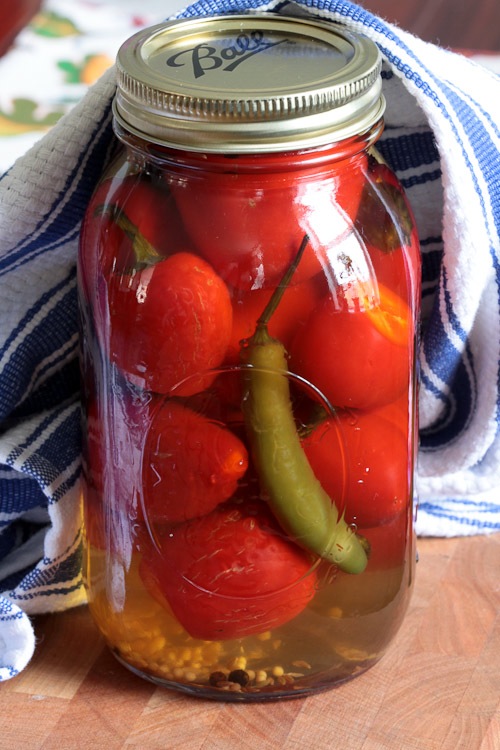
Cold Pickled Cherry Peppers
I had this request the other day, and I remembered that it’s time to put up my hot cherry and jalapeno peppers. This is the simple method for preserving those hot beauties. I love having them around all winter, to eat with sandwiches, or stuff with cream cheese or ham to serve at a party.
Pickled Peppers
* 5 pounds cherry peppers, or a mix of your choice of peppers
* 1 Jalapeno per jar (if desired for hotness)
* 1 clove garlic per jar
* 6 cups vinegar
* 2 cups water
* 1 tablespoon plus 1 teaspoon pickling salt
* 1 tablespoon sugar, if desired
*Note: May use a variety of peppers to equal 5 pounds (4 quarts).
Yield: Makes 7 to 8 pints
Procedure: Wash peppers. I like to leave my peppers whole, and cut a small “X” across the bottom of each pepper. Stem and core large peppers. Pack one clove garlic and whatever peppers you have tightly into clean, hot, sterilized jars, leaving 1/2-inch headspace. Combine vinegar, water, salt (and sugar). Bring to boil and reduce to simmer. Pour hot pickling solution over peppers, leaving 1/4-inch headspace. Push the peppers down firmly in the jar to remove all the air bubbles. Work the hard in the jar to get the brine inside the peppers, and keep pushing until no more bubbles rise to the surface. Readjust headspace to 1/4 inch. Wipe jar rims. Add pre-treated lids and process in boiling water bath. For best flavor, store jars five to six weeks before opening.
The Easiest Home-Made Bread You’ll Ever Make
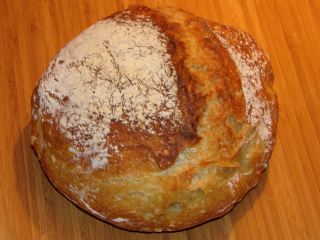

In the Lancaster Sunday News on August 8 we ran a piece on a fabulous Panzanella (tomato and bread salad). It occurred to me today that while the recipe is fabulous, and easy to make, what it begs for, and wasn’t mentioned in the article, was that it would be even better with a homemade bread. Now I recognize that making bread is not everyone’s cup of tea, mostly because it isn’t an easy thing to do for a novice, we have for years made a wonderful crusty white bread from a recipe published in the New York Times in November of 2006. The beauty of that bread is that it requires no kneading. Just mix the ingredients, show some patience during two rise periods, and discover the easiest bread this side of an electric bread maker, but so much better.
The Times’s recipe is great, but the results can be less than perfect and the product inconsistent if the baker varies even a tiny bit from the original recipe. There have been numerous bakers who have taken the challenge of making the bread better and easier to make. I have found one that I adore, and while it does require just a bit of kneading, it is about the best bread I know, is truly easy to make–even for a beginner–and works perfectly every time. It comes from one of my favorite cooking resources, Cook’s Illustrated (I’ve implored you several times to pony up the fee to subscribe to their web site; it’s the best cooking site on the Internet. Do give it a try), and it is the best bread match for the panzanella recipe I wrote about in August. That recipe is linked here, and is worth your time. And if you’re really ambitious, bake the bread as well. It’s a winner.
Almost No-Knead Bread
Makes 1 large round loaf. Published January 1, 2008. From Cook’s Illustrated.
An enameled cast-iron Dutch oven with a tight-fitting lid yields best results, but the recipe also works in a regular cast-iron Dutch oven or heavy stockpot. (See the related information in “High-Heat Baking in a Dutch Oven” for information on converting Dutch oven handles to work safely in a hot oven.) Use a mild-flavored lager, such as Budweiser (mild non-alcoholic lager also works). The bread is best eaten the day it is baked but can be wrapped in aluminum foil and stored in a cool, dry place for up to 2 days.
Ingredients
| 3 | cups unbleached all-purpose flour (15 ounces), plus additional for dusting work surface |
| 1/4 | teaspoon instant or rapid-rise yeast |
| 1 1/2 | teaspoons table salt |
| 3/4 | cup plus 2 tablespoons water (7 ounces), at room temperature |
| 1/4 | cup plus 2 tablespoons mild-flavored lager (3 ounces) |
| 1 | tablespoon white vinegar |
Instructions
- 1. Whisk flour, yeast, and salt in large bowl. Add water, beer, and vinegar. Using rubber spatula, fold mixture, scraping up dry flour from bottom of bowl until shaggy ball forms. Cover bowl with plastic wrap and let sit at room temperature for 8 to 18 hours.
- 2. Lay 12- by 18-inch sheet of parchment paper inside 10-inch skillet and spray with nonstick cooking spray. Transfer dough to lightly floured work surface and knead 10 to 15 times. Shape dough into ball by pulling edges into middle. Transfer dough, seam-side down, to parchment-lined skillet and spray surface of dough with nonstick cooking spray. Cover loosely with plastic wrap and let rise at room temperature until dough has doubled in size and does not readily spring back when poked with finger, about 2 hours.
- 3. About 30 minutes before baking, adjust oven rack to lowest position, place 6- to 8-quart heavy-bottomed Dutch oven (with lid) on rack, and heat oven to 500 degrees. Lightly flour top of dough and, using razor blade or sharp knife, make one 6-inch-long, 1/2-inch-deep slit along top of dough. Carefully remove pot from oven and remove lid. Pick up dough by lifting parchment overhang and lower into pot (let any excess parchment hang over pot edge). Cover pot and place in oven. Reduce oven temperature to 425 degrees and bake covered for 30 minutes. Remove lid and continue to bake until loaf is deep brown and instant-read thermometer inserted into center registers 210 degrees, 20 to 30 minutes longer. Carefully remove bread from pot; transfer to wire rack and cool to room temperature, about 2 hours.
Fresh Peach Ice Cream

I promised a second peach ice cream recipe, one with eggs. Here it is. This is incredible. Make this, and follow the recipe exactly. As I suggested in the “no-egg” ice cream recipe, follow your ice cream freezer maker’s directions exactly. If the instructions say 20 minutes, don’t do it for 21 or 22. Freezing the ice cream longer than recommended makes it icy. I know. I’ve tried doing in longer and shorter. The ice cream freezer maker (in my case Cuisinarts, spent millions on research to develop a perfect product. They know whereof they speak.
Both the cooked peaches and the custard mixture must be cooled to 40 degrees before you churn them. Since they are fine in the refrigerator overnight, you may want to prepare them the day before you plan to churn and serve the ice cream. You’ll get the very best results from using in-season, fully ripened peaches, and for a terrific treat, replace the vodka with peach-flavored liqueur or Amaretto. The ice cream is at its peak when eaten within four hours of churning, although covered, it will keep in the freezer for up to two days.
Ingredients
| 3 | medium-size ripe peaches , peeled, pitted, and cut into 1/2-inch pieces (about 2 cups) |
| 1/2 | teaspoon lemon juice from 1 lemon |
| pinch table salt | |
| 1 | cup granulated sugar |
| 6 | tablespoons granulated sugar |
| 1 1/4 | cups whole milk |
| 1 1/3 | cups heavy cream |
| 6 | large egg yolks |
| 1 | teaspoon vanilla extract |
| 2 | tablespoons Absolut Peach vodka |
Instructions
1. 1. Stir peaches, lemon juice, a pinch salt, and 1/2 cup sugar in medium-size nonreactive saucepan to combine; let stand until a pool of syrupy liquid accumulates and peaches soften slightly, 1 to 1 1/2 hours.
2. 2. Position sieve over medium bowl set in an ice-water bath; set aside. Heat milk, cream, and 1/2 cup sugar in medium-size heavy saucepan over medium heat, stirring occasionally, until steam appears, 5 to 6 minutes. Turn off heat. Meanwhile, whisk yolks and remaining 6 tablespoons sugar in medium bowl until pale yellow. Stir half the warmed milk mixture into beaten yolk mixture until just blended. Return milk-yolk mixture to saucepan of remaining warmed milk mixture. Heat milk-yolk mixture over medium-low heat, stirring constantly with wooden spoon until steam appears, foam subsides, and mixture just begins to thicken (see illustrations below) or instant-read thermometer registers 180 degrees (mixture must not boil or eggs will curdle). Remove from heat, and following step 3 in illustration, immediately strain custard into prepared bowl. Cool custard mixture to room temperature, stir in vanilla, then cover and refrigerate until instant-read thermometer registers 40 degrees, at least 2 and up to 24 hours.
3. 3. Meanwhile, heat softened peaches and their liquid, stirring occasionally, over medium-high heat until peaches are tender and flesh has broken down, 3 to 4 minutes. Transfer to bowl, stir in vodka, and refrigerate until cold, at least 4 and up to 24 hours.
4. 4. Strain chilled peaches, reserving liquid. Stir reserved peach liquid into chilled custard mixture; pour into ice cream machine canister and churn, following manufacturer’s instructions, until mixture is frozen and resembles soft-serve ice cream, 25 to 30 minutes. Add peaches; continue to churn until combined, about 30 seconds longer. Transfer ice cream to airtight container. Freeze until firm, about 2 hours.
Makes about 1 quart.
Peach Salsa
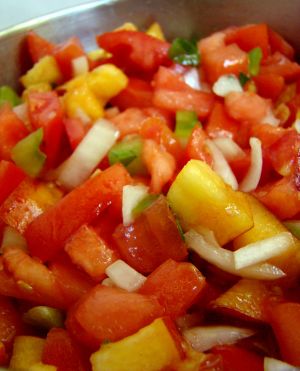
Peaches are ripe and bursting right now, and I’m always on the lookout for out-of-the-box recipes to post for whatever is in season. I was treated the other day to a homemade salsa that was fresh and tasty, and, having enjoyed variations of mango salsa, I suggested that one might try making a salsa with peaches. My friend looked stunned, but was willing to consider the possibility. So I said I’d find one and give him the recipe. Here is one that looks pretty good:
Ingredients:
6 medium-size ripe peaches, peeled and chopped
4 Roma tomatoes, skinned and chopped (do you know how to skin tomatoes? I’ll remind you at the end of this post)
2 serrano chiles, seeded and finely chopped
3 green onions, chopped
1/4 cup red onion, chopped
1 firm avocado, skinned and chopped
4 tablespoons extra-virgin olive oil
2 tablespoons sherry vinegar
2 tablespoons fresh cilantro, chopped fine
juice of 1 lime
juice of 1 lemon
pinch of Kosher salt and freshly ground black pepper
Preparation:
In a large bowl, combine peaches, tomatoes, chiles, onions, and avocado. Stir gently to blend.
In a small bowl, whisk together olive oil, vinegar, cilantro, and the citrus juices. Pour over the vegetables and toss.
Add salt and pepper to taste.
Serve with tortilla chips. Blue corn chips are even better, and look great!
Skinning tomatoes:
Prepare a large non-reactive bowl with water and ice.
Bring 6 inches of water to a rolling boil in a large stock pot.
Cut a small, shallow X on the bottom end of the tomatoes (opposite the stem end), barely piercing the skin.
Carefully place the tomatoes into the boiling water for exactly one minute.
Remove the tomatoes from the boiling water and drop them into the ice water. Allow the tomatoes to cool completely.
You can now easily peel the skins off the tomatoes.
Compost the skins!
Brook Lawn Farm Market
Here is a link to the best farm market I know. Brook Lawn Farm Market, in Lancaster ,PA
Philadelphia-Style Peach Ice Cream
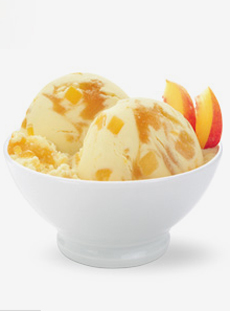
I had a request recently for an ice cream recipe that contained no eggs. There are two main kinds of ice cream in the U.S., custard-style ice cream and Philadelphia-style ice cream. So that it is clear what the differences are, think of it this way: Haagen Dazs and Ben & Jerry’s ice creams and gelati are custard-style frozen desserts, and Breyer’s and Turkey Hill Philadelphia-style are “Philadelphia-style ice creams. Since Breyer’s mint chocolate chip and vanilla are my two favorite ice creams, I guess I like this one better.
I was discussing ice cream the other day with my peaches purveyor the good folks at Brooklawn Farm Market, and the subject of peach ice cream came up. One of the girls in the store asked me if I knew a good peach ice cream recipe, since she is allergic to eggs. So I went to work, and came up with this little gem. Try this for a wonderful treat. The key here is to follow your ice cream maker’s instructions exactly. If I’ve learned something from making ice cream, it’s that my ice cream maker, the Cuisinarts (Cooks’ Illustrated’s favorite one) recommends freezing for 20 minutes, and doing it longer makes the finished product worse, not better. So try this and let me know how it works out.
Philadelphia-Style Peach Ice Cream.Prep Time: 15 minutesCook Time: 5 minutesTotal Time:20 minutesFreezing time: 20 minutes
Ingredients:
- 1-1/2 cups heavy cream
- 1 1/2 cups whole milk
- 2/3 cup sugar
- 3 large, sweet peaches, peeled and pitted
- 1/2 cup peach nectar
- 1/2 teaspoon vanilla extract
- 1/2 teaspoon Kosher salt
Preparation:
Heat the cream in a heavy medium saucepan over medium heat until small bubbles appear around the edge. Do not let the cream boil. Remove from the heat and add the salt and sugar, stirring until they dissolves completely. Cool to room temperature. Cut the peaches into eighths and place in the blender with the peach nectar. Blend until the peaches are almost pureed, but leave some small pieces of peach. Stir the peach purée and vanilla into the cooled cream. Cover with plastic wrap so that the wrap rests directly on the mix and refrigerate until cold or overnight. Freeze in 1 or 2 batches in your ice cream machine according to the manufacturer’s instructions. When finished, the ice cream will be soft but ready to eat. It’s wonderful that way, but to make it even better, transfer to a freezer-safe container and freeze at least 2 hours. Makes about 6 cups
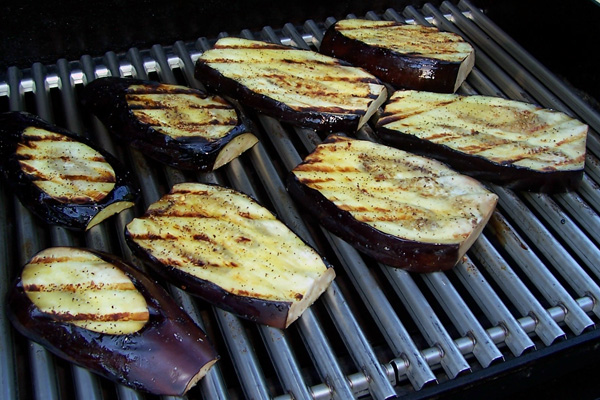
Grilled Eggplant
A recent request got me to looking through my collection for a simple, tasty approach to eggplant in the summer. I like this one, served with thick slices of Jersey tomatoes that have been drizzled with good olive oil and fresh-chopped oregano.
BASTING SAUCE:2 minced garlic cloves
2 tbsp. minced fresh parsley
2 med. eggplants
2 tsp. salt
1/4 c. chopped fresh basil
3/4 c. olive oil Combine all ingredients for the basting sauce and let stand for one hour.While the oil is standing, slice the eggplant crosswise into 1/2 inch slices. Arrange the slices in one layer on a large rack set over a tray and sprinkle them with half the salt. Turn the slices, sprinkle with remaining salt and let drain, turning them once for one hour. Pat the slices thoroughly dry with paper towels. Brush one side of each slice with the basting sauce and grill the slices, oiled side down on an oiled rack set 3 to 4 inches above glowing coals. Grill for about 3 minutes per side. Brush with more oil and turn them. Grill for about 3 to 4 minutes more or until they are browned and tender. Transfer grilled slices to a platter. Drizzle with a small amount of any remaining oil. Sprinkle with ground pepper to taste. Chill the eggplant, covered, for at least 4 hours or overnight. Serve them cold or at room temperature as a salad or appetizer with sliced French bread.
Key Lime Bars … Best Dessert EVER!
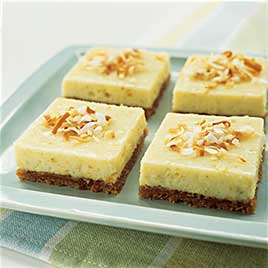
Those of you who are regular readers know of my specific love of all things Key Lime–comes from my years in South Beach and of making those magnificent Key lime pies for that famous restaurant down beach. If you are new to the site, check out my very first post, all the way back at the beginning.
So, what is the Key lime treat today? I subscribe to Cook’s Illustrated (which is in my opinion the best cooking publication on the planet), and get emails from them highlighting new, fabulous and thoroughly tested recipes from their test kitchen. I got this recipe from them, emailed to me, with an attached video showing how they are made. Given my love for Key lime products, I gave them a try. Voila! The best Key lime dessert I have ever tasted! Bar none (get it?).
I made these bars for an outdoor gathering of Ellen’s book group last summer. She tasted one bar and told me I could NOT give one single bar to anyone else. That’s how good they are. She also insisted that I never, ever, make them again. We almost finished them in one sitting.
So I am presenting to you here, the most fabulous bar cookie recipe I have ever tasted, that I have ever made. I will never make them again. (HAR!)
.
The recipe uses a crust made from, of all things, animal cracker crumbs. i’f you’ve not tried an animal-cracker crust, try it, and you will discover a rare treat that will change the way you view crumb crusts forever. The only quibble I have with the original recipe is that they suggest real Key limes, and if they are not available, use regular limes. I can say from personal experience that: a) Key limes are a pain to work with, b) they are hard to find and expensive, c) you need too many to make the recipe, and d) the recipe is actually easier and, frankly, better, if you use a half and half blend of fresh lime and fresh lemon juice. The blend of juices perfectly reproduces the combination of sweet, sour, and tart of Key limes.
This recipe is adapted from the July 1, 2006 edition of Cook’s Illustrated, and the video is available at their web site, http://www.cooksillustrated.com. You must be a paying member to see the video, but I promise that this recipe alone is worth the price of admission. I’ve recommended this site before, and I stand by my recommendation. I don’t like very many subscription sites, but Cook’s Illustrated is an exception.
Key Lime Bars
Start with a half-and-half blend of regular (Persian) lime and lemon juices. Do not use bottled lime juice. Grate the zest from the 1 lime before juicing it (2 if you’re doubling the recipe), avoiding the bitter white pith that lies just beneath the outermost skin. The optional coconut garnish adds textural interest and tames the lime flavor for those who find it too intense. The recipe can be doubled and baked in a 13- by 9-inch baking pan; you will need a double layer of extra-wide foil for the pan (each sheet about 20 inches in length) and should increase the baking times by a minute or two.
Ingredients
| Crust | |
| 5 | ounces animal crackers |
| 3 | tablespoons packed brown sugar (light or dark) |
| 1 | pinch Kosher salt |
| 4 | tablespoons unsalted butter , melted and cooled slightly |
| Filling | |
| 2 | ounces cream cheese , room temperature |
| 1 | tablespoon grated lime zest , finely minced |
| 1 | pinch Kosher salt |
| 1 | (14-ounce) can sweetened condensed milk |
| 1 | egg yolk |
| 1/4 | cup freshly squeezed lime juice |
| 1/4 cup freshly squeezed lemon juice
Garnish (optional) |
|
| 3/4 | cup sweetened shredded coconut , toasted until golden and crisp |
Instructions
- 1. Adjust oven rack to middle position and heat oven to 325 degrees. Cut about 12-inch length extra-wide heavy-duty foil; fold cut edges back to form 7 1/2-inch width. With folded sides facing down, fit foil securely into bottom and up sides of 8-inch-square baking pan, allowing excess to overhang pan sides. Spray foil with nonstick cooking spray.
- 2. TO MAKE THE CRUST: In workbowl of food processor, pulse animal crackers until broken down, about ten 1-second pulses; process crumbs until evenly fine, about 10 seconds (you should have about 1 1/4 cups crumbs). Add brown sugar and salt; process to combine, ten to twelve 1-second pulses (if large sugar lumps remain, break them apart with fingers). Drizzle butter over crumbs and pulse until crumbs are evenly moistened with butter, about ten 1-second pulses. Press crumbs evenly and firmly into bottom of prepared pan. Bake until deep golden brown, 18 to 20 minutes. Cool on wire rack while making filling. Do not turn off oven.
- 3. TO MAKE THE FILLING: While crust cools, in medium bowl, stir cream cheese, zest, and salt with rubber spatula until softened, creamy, and thoroughly combined. Add sweetened condensed milk and whisk vigorously until incorporated and no lumps of cream cheese remain; whisk in egg yolk. Add lime and lemon juice and whisk gently until incorporated (mixture will thicken slightly).
- 4. TO ASSEMBLE AND BAKE: Pour filling into crust; spread to corners and smooth surface with rubber spatula. Bake until set and edges begin to pull away slightly from sides, 15 to 20 minutes. Cool on wire rack to room temperature, 1 to 1 1/2 hours. Cover with foil and refrigerate until thoroughly chilled, at least 2 hours.
- 5. Loosen edges with paring knife and lift bars from baking pan using foil extensions; cut bars into 16 squares. Sprinkle with toasted coconut, if using, and serve. (Leftovers can be refrigerated up to 2 days; crust will soften slightly. Let bars stand at room temperature about 15 minutes before serving.)
Step-by-Step
Building Key Lime Bars
 1. Line pan with foil sling, then coat with cooking spray.
 2. Press crumb mixture firmly and evenly into pan.
 3. Pour filling into prebaked crust and spread into corners.
Are you growing your own herbs?

Are you growing your own herbs?
The foundation of any good kitchen is the tools and supplies you have on hand that find their way into all the cooking that you do. This includes knives, pots and pans, basic condiments–salt, pepper, garlic, ginger, ketchup, mustard, mayonnaise–and the basic ingredients you use on a regular basis.
This includes, of course, herbs and spices.
Spices I will leave for another discussion, but what I’m about here is herbs. The ones you use all the time, and maybe don’t even think about until either a recipe calls for a teaspoon of dried cilantro or dill or oregano, you reach for the little bottle in the cupboard by the stove and there’s not enough for the recipe. Do you know where your thyme came from? Your oregano? Your sage? Did they ride in a truck for hours? How many gallons of diesel fuel did they use? Were there pesticides on them? Were they washed? What do you really know?
I say, grow your own. Many of you probably do, and if so, you know that there’s not much better than whipping up a quick mushroom and cheese omelette and snipping a few chives to complete the dish. Homemade marinara with fresh parsley and basil? A snap, and so much better than store-bought.
Growing your own herbs is: a) simple; b) cheap; c) delicious; d) interesting–there are so many varieties of herbs to try, just sticking to the basics; we’ve grown three or four different basils and at least three different thymes; and e) rewarding–both in the sense of pride you feel from adding homegrown ingredients to your food, and for the compliments you’re likely to get from company who don’t know why that red sauce tastes better, but it does.
People who do their own herbs do it in all kinds of ways–herb-garden window boxes, and setting up a section of their vegetable garden are common. We grow ours in pots outside our kitchen door. A little water every day or two in the summer–not too much, herbs like to be a bit on the dry side– and a little advance planning, and you won’t be buying expensive little bottles of herbs at the grocery store any more. Where do those herbs come from anyway?
Grow any herbs you like, most will flourish here and where you live if you provide just a little bit of care. The real trick to successful herb gardens is to harvest often. Don’t let the herb plants get too big. Like any other plant, the more you prune the bigger the plant will get, so prune them often. Cut herb plants back frequently–usually when they outgrow the perimeter of the pot or when they look just a little out of control in the garden. Cut a large bunch, tie them up with string and hang them in a warm, dry, dark place–I do it in my garage–and forget about them for about three or four weeks. When they are dry to the touch and crumble easily, place the dried bunch in a large steel mixing bowl and crumble them to bits. Pick out and discard the stems and pour the dried leaves into nice little herb bottles you got at the dollar store or saved from when you ran out of thyme (get it?).
We grow thyme, oregano, basil, parsley, sage, cilantro, chives, and mint (actually, our mint is out of control in the backyard, but it grows really well in pots). We harvest them for dried herbs to use in the winter, but here’s an added bonus: if you grow them in small pots, bring them into the house in the fall and keep them as house plants and keep harvesting. What I’ve discovered, however, is that in spite of recommendations to the contrary, most herbs overwinter very nicely in a garage. Simply put the pots on a shelf in a cold (but not freezing) garage, near a window if you have one, give them a little water about once every two weeks, and in the spring after the freeze is gone, most of them will come back, usually even stronger. I haven’t done this with basil–we use enough basil all year long that I try to keep a pot of basil growing in the kitchen– so I’m not sure how that overwinters. Or, you can just let the basil go in September, harvest a bunch just before the first freeze, and make a load of pesto, for home use or for holiday gifts.
Fresh and local. What could be better?
Zucchini-Parmesan Risotto
Lancaster Sunday News for June 27. Zucchini-Parmesan Risotto, and what a dish!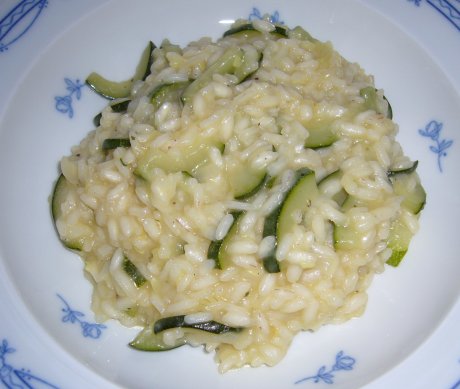
I went out to our backyard garden the other day to discover that my first zucchini of the season was ready for picking, and in this house, that means it’s time for…
Comfort food, summer style.
When I mention comfort food to the kids they immediately think of macaroni and cheese. I liked it too when I was a kid, but now I’m an adult, and I’ve come across a grown-up rendition of this classic, one that tickles my comfort-food fancy, and is garden-fresh and healthy to boot.
What we’re serving up today is a creamy, cheesy side-dish delight, zucchini-Parmesan risotto topped with a wonderful tomato and olive compote. You probably think that risotto is time-consuming, difficult to make, and even harder to make right. Think again. It takes about the same time, start to finish, as the kids’ favorite, but is so much more satisfying.
The recipe is driven by the appearance of home-grown, garden-fresh vegetables–you may be seeing tomatoes if you planted early–but the local farm markets are already serving up the goods in plentiful amounts. And for those red-meat eaters in your house, it is a perfect complement for steaks on the grill, an ultimate summer comfort-food plateful.
Here’s what you do:
Ingredients:
Risotto
2 tablespoons olive oil
1 cup minced onion
2 garlic cloves, minced fine
¾ cup uncooked Arborio rice
½ cup white wine
½ teaspoon salt
2 – 2 ½ cups vegetable broth, kept at a low simmer
1 medium zucchini, grated (about 1 ½ cups)
2/3 cup grated Parmesan cheese
fresh ground pepper to taste
Tomato Compote
3 ripe plum tomatoes, seeded and chopped
½ cup minced onion
15 pitted Kalamata olives (optional)
¼ cup fresh basil leaves, chopped
salt and fresh-ground pepper to taste
To make the risotto, heat a large, heavy pot (preferably enamel) and 1 tbsp. olive oil over medium-high heat. Add 1 cup onions and saute’ until they soften, about 5 minutes. Add the garlic and rice and saute’, stirring, about 2 minutes. Add the wine and salt and cook and stir until the wine has almost evaporated. Add ½ cup broth and let the rice cook, stirring frequently, until the broth has been absorbed, then add another ½ cup broth and continue stirring. When the rice has been cooking for 10 minutes, add the zucchini and stir to combine. Each time the broth is almost completely absorbed, add another ½ cup, until the broth is gone, or until the rice is tender but still a little chewy, about 25-30 minutes. Remove the risotto from the heat, add the Parmesan cheese and fresh-ground pepper, stir well and cover. Let the pot rest about 10 minutes before serving. It will thicken a bit more.
While the risotto is resting, make the tomato compote. Heat a pan medium high with 2 tbsp. olive oil, and then add the chopped tomatoes. When the tomatoes are hot, add the minced onions and saute’ about 1 minute. Remove the pan from the heat and add the olives, basil, salt and pepper, and mix well. Serve the risotto with a dollop of tomato compote, and garnish with grated Parmesan and fresh basil leaves, sliced into julienne strips.
For a snazzy presentation, transfer the risotto to a bowl and chill for ½ hour. Then divide the risotto and shape into six pancakes, about 1 inch thick. Heat 2 tablespoons olive oil in a heavy skillet over high heat, turn the heat down a bit and sear the cakes about 3-4 minutes on each side, until they are nicely browned. Serve the risotto cakes topped with compote, cheese, and basil garnish.
If you’re not a fan of marinated olives, make the compote without them. My kids like the dish almost as much as they do their favorite mac and cheese, but they prefer it without the compote topping. It’s still a fabulous dish that veritably screams: “COMFORT FOOD!”
The recipe comes courtesy of Didi Emmons’ classic Vegetarian Planet. If you’re interested in experimenting with different and delicious vegetable dishes, it’s one you ought to have on your kitchen bookshelf.
 Cheffzilla’s Kitchen