Hearty Mushroom-Barley Soup…Moosewood Style
The first thing I want to report in this entry is that I love—LOVE!!!—the Moosewood Restaurant in Ithaca, NY. For years I have used and featured recipes from the various Moosewood cookbooks; one of my all-time favorites is Moosewood Celebrates. It is chock full of holiday-specific recipes for just about as many holidays that you can imagine.
And this being the coldest part of the coldest winter in my memory, I thought I’d cook my go-to meal for a winter Sunday evening. 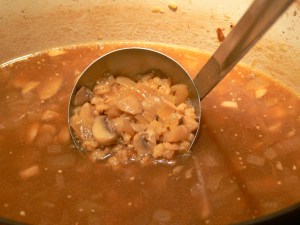
Soup.
You all know of my affinity for soups. I love making soups—creamy soups, hearty soups, beefy soups, chickeny soups, veggie soups—there isn’t a soup I won’t try.
But this week, I’m turning back to what I know and love best: Moosewood.
This recipe comes from the original book, The Moosewood Cookbook. Compiled and written by Molly Katzen and published in 1977, The Moosewood Cookbook is a beautiful-to-look-at-and-read cookbook, with lovely pen-and-ink drawings instead of photographs, a typeface reminiscent of hand-written recipes, and one of the best collections of down-home vegetarian recipes that don’t scream VEGETARIAN!!!, but rather present tasty entries that a whole family can enjoy without feeling like they are eating nuts and twigs. This is a soup I made a variation of at the gourmet store in Miami, and was one of our favorites. Herewith, I present to you the Moosewood Restaurant version of one of our all-time faves:
THE MOOSEWOOD RESTAURANT MUSHROOM-BARLEY SOUP
Ingredients:
½ cup raw pearled barley
1 ½ cups water
5 cups vegetable stock
1 teaspoon kosher salt
4 tablespoons tamari
4 tablespoons dry sherry
3 tablespoons unsalted butter
2 cloves garlic, minced fine
2 small-to-medium onions
1 pound fresh mushrooms, sliced white mushrooms
Preparation:
Cook the barley in 1 ½ cups water for 45 minutes at very low heat. Do it right in the soup pot. Add the stock, tamari and sherry and continue to simmer.
Saute the onions and garlic in the butter slowly, until they begin to brown lightly and start to caramelize. When they begin to soften, add the mushrooms and salt. When the mushrooms are tender, add to the simmering soup. Make sure to get all the liquid that is rendered by the onions and mushrooms.
Give the soup a generous grind of fresh black pepper and simmer 20 minutes over the lowest possible heat. Taste and add salt and pepper if necessary. Serve with fresh, warm, crusty bread.
I can’t begin to tell you just how wonderful this soup is; it’s reminiscent of the best French onion soup you’ve had, and so much more. It’s fragrant and hearty; it’s thick enough to stick to your ribs in winter, and at the same time tasty enough to serve to company. Try this one. It’s an oldie but goodie, and not much has come across my table that is much better.
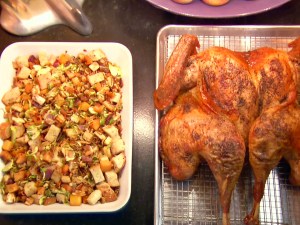
Butterflied Turkey, Root Vegetable Panzanella, and Mushroom Barley Pilaf
And what, pray tell, do you think Cheffzilla might be doing for Thanksgiving this year? Really adventurous, I might say, but mighty tasty, too. Allow me to elaborate:
I adapted these recipes a few years ago from ones featured on his “Good Eats” show a couple of years ago by Alton Brown, that wacky TV chef at the Food Network. It turned out so well that it’s become my go-to turkey presentation. I’ve become a devoted advocate of the “spatchcock” method of poultry cooking, as it both cuts down on cooking times, and also allows for a wide range of possibilities in preparing companion dishes. Also, I’m a big fan of panzanella, and this recipe demonstrated to me that it’s not just a summer salad. Beautiful root vegetables, winter squash, shredded Brussels sprouts, a fine sourdough bread, and some fresh herbs from my garden (yes, it is still producing, under a big window in the garage!) make for a really fine-looking and grand holiday dinner, a wide stray from the usual turkey-and-stuffing tradition of years past. Here’s what’s for dinner:
Great any night.
A holiday feast? Priceless!
 3 1/2 tablespoons kosher salt
1 1/2 teaspoons rubbed sage
1 1/2 teaspoons dried thyme
1 1/4 teaspoons whole black peppercorns
1/2 teaspoon whole allspice berries
1 12- to 15-pound whole turkey, neck and giblets removed and reserved for Giblet Stock
Panzanella:
1 1/2 pounds parsnips, peeled and cubed into 1/2-inch pieces
1 1/2 pounds rutabaga, peeled and cubed into 1/2-inch pieces
2 tablespoons extra-virgin olive oil
1/2 pound red onion, diced into 1/2-inch pieces
8 ounces butternut squash, diced into 1/2-inch pieces
1 quart container fresh Brussels sprouts, sliced
8 ounces stale, hearty sourdough or multi-grain bread, cut into 3/4-inch cubes
2 cloves garlic, minced
1/4 cup apple cider vinegar
1/4 cup fresh thyme leaves, finely minced
Kosher salt
Freshly ground black pepper
Directions
For the turkey: Four days before service, place the salt, sage, thyme, black peppercorns, and allspice into a spice grinder and pulse until the peppercorns and allspice are coarsely ground, 5 to 6 pulses. Set aside.
Set the turkey, breast-side down, on a large cutting board with the tail closest to you. Use heavy-duty kitchen shears or a large chef’s knife to cut up one side of the backbone. Turn the bird around and cut back down the other side of the spine. Reserve the backbone for Giblet Stock. Discard any fat pockets or excess skin found inside the turkey. Turn the turkey breast-side up and use the heel of your hands to press down on both breasts, until you hear a cracking sound and the bird has flattened slightly.
Rub the seasoned salt on both sides of the turkey. Place the turkey on a parchment paper lined half sheet pan, breast-side up with legs running with the long side of the pan. Store, uncovered, in the refrigerator for 4 days.
Remove the turkey from the refrigerator and leave at room temperature for 1 hour.
For the panzanella: Place the parsnips and rutabaga in a large bowl, toss lightly to coat with the oil, and set aside.
Place one rack in the middle of the oven and a second one far enough below so the roasting pan will fit. Heat the oven to 425 degrees F.
Place the turkey directly on the olive-oil-coated middle rack of the oven with the legs perpendicular to the metal bars of the rack. Place the roasting pan with the parsnips and rutabaga on the rack below the turkey and roast both for 30 minutes.
Reduce the heat to 350 degrees F. Add the red onion to the roasting vegetables and stir to combine. Continue to roast both the vegetables and the turkey until a probe thermometer inserted into the thickest part of the breast registers 155 degrees F, an additional 40 to 50 minutes.
Remove the turkey from the oven onto a cooling rack set inside a half sheet pan and rest for 30 minutes.
Add the butternut squash, Brussels sprouts, bread cubes and garlic to the roasting vegetables, stir to combine and roast for an additional 15 minutes. Remove the vegetables from the oven and immediately transfer to a serving bowl. Pour the apple cider vinegar in the warm roasting pan, stir and scrape off any browned bits from the pan. Pour the vinegar mixture over the salad, add the thyme and toss to combine. Season with salt and pepper as desired. Serve warm or at room temperature.
Carve the turkey and serve with the panzanella.
Barley and Portabella Pilaf
Ingredients: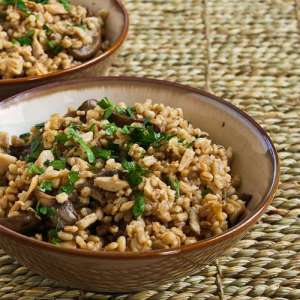
1/2 cup fresh sliced Portabella mushrooms
2 teaspoons olive oil
2 cup pearled barley
2-1/2 cups turkey (or vegetable) stock
2 tablespoons green onions (scallions)
1/4 tsp crushed dried rosemary
2 tablespoons grated fresh Parmesan cheese
Preparation:
Heat olive oil in a saucepan; add mushrooms and saute’ until limp. Add barley, stock, green onion, and rosemary. Bring to a boil. Reduce heat to low, cover and cook 45 minutes, or until the barley is tender and the liquid is completely absorbed. Sprinkle Parmesan cheese over pilaf and toss to mix well. Garnish with a little more Parmesan and some fresh-chopped green onions.
Serve immediately.
We’re serving this with fresh green beans sauteed in butter with sesame seeds and cranberry-orange relish.
Yum.
Cheffzilla’s Choice: Seafood Risotto
I had a plate of seafood risotto the other night at a restaurant that I had been avoiding for years. And it was memorable.
Whoops.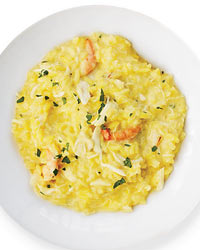
Why had I been avoiding it? Location, looks from the outside, lack of vision, obstinance, who knows? It just didn’t feel right where it was. An Asian-fusion restaurant at the confluence of two major roads in Lancaster, PA, and the fact that the building looks like it hadn’t had the outside washed in years (the amount of car traffic passing by every day doesn’t help), plus my wife’s flat refusal to try the place.
If there was ever a perfect example of “looks can be deceiving,” this place is it.
Blue Pacific Sushi and Grill, at the confluence of Oregon Pike and Lititz Pike, in Manheim Township, Lancaster County.
Surprisingly good.
So I decided to try to either replicate the dish or make my own even better. But the idea of seafood risotto really rings happy in my ears, so I had to try one of my own. Here’s the result. Not exactly the same as Blue Pacific’s entree, but I’ll stand mine up against theirs (and anyone else’s) any day. It’s worth a try.
CHEFFZILLA’S OWN SEAFOOD RISOTTO
Ingredients:
6 cups seafood stock (8 cups water, shells from 1-2 dozen medium shrimp, 1 teaspoon celery salt, tops from 1 bunch of celery, and 1 bay leaf, simmered uncovered for 30 minutes)
1 16-ounce bottle clam juice
1-2 dozen medium (26-31-count) shrimp, peeled and deveined
1 dozen sea scallops, washed
1 cup lump crabmeat
1/4 cup salted butter
1 large sweet onion
2 cups Arborio rice
3/4 cup dry white wine
1 teaspoon fresh thyme, chopped fine
2 teaspoons Old Bay (or Creole) seasoning, or more, to taste
1/2 teaspoon saffron threads
Kosher salt and freshly ground pepper, to taste
1/2 cup grated Gruyere cheese
1/4 cup freshly chopped parsley for garnish
Spanish paprika for garnish
Preparation:
1. Peel the shrimp, place the shells, the celery salt, a bay leaf, the celery leaves and the clam juice in water, bring to a boil, reduce the heat and simmer, uncovered, for 30 minutes. Strain the solids out, put the stock back in the pot, cover, and keep warm.
2. Melt the butter in a large, heavy pot, add the onions and saute over medium heat until transparent, about 10 minutes. Do not brown. Add the rice and saute, stirring constantly, until it is transparent, 3-5 minutes. Don’t allow the rice to brown. Add the wine and cook, stirring constantly, until the wine is competely evaporated. Add 1/2 cup stock and stir until most of the stock is absorbed. Add the thyme and saffron and another 1/2 cup stock, stir until it is mostly evaporated, and repeat, adding 1/2 cup of stock at a time until the rice is almost al dente, 20-30 minutes.
3. Add the seafood and 1/2 cup stock and stir until the shrimp and scallops are firm. and the stock has evaporated. Season with Old Bay or other Creole or seafood seasoning until you can taste it but the taste is not overpowering. Season with additional salt and pepper if necessary.
4. Add 1/2 cup stock to the pot, stir rapidly for 30 seconds, then ladle the risotto into oven-proof bowls, sprinkle lightly with Gruyere cheese, and place under the broiler just until the top and edges begin to brown. Remove from the oven, garnish with paprika and parsley, and serve immediately.
Canning a Fabulous Marinara Sauce–Quickly and Simply
This is going to be a short note about canning and tomato sauce.
 I know…I know…there are a billion places on the web where you can get canning advice, and there are even more tomato-sauce recipes, likely you make your grandmother’s recipe (or your mother’s recipe, or a neighbor’s recipe, or Alton Brown’s recipe or…or…or…
I’m going to add one more voice to the Greek Chorus, and while these are probably the most overused food-column subjects on the planet, I humbly suggest you actually try this one, because it is so bloody simple and so bloody tasty that I may actually influence you to give up your day-long adventure in kitchen drudgery, which most tomato sauces tend to be–no self-respecting grandmother I know would ever subscribe or give props to a sauce that doesn’t simmer all day, and which likely takes even longer to clean up. Besides, the longer you simmer, the more sugar you’ll have to add, because long simmering makes tomatoes bitter, not better (notice there’s no sugar in my recipe? Just a little in the ketchup to offset the vinegar a bit. Is there sugar in your recipe?).
No sir or ma’am, I don’t roll in that direction. If you’ve read this space before, you know that perhaps only second to fresh and local, I am all about quick and simple. I have teen-age daughters. I don’t have time to spend all day in the kitchen. And don’t bother removing the skins and seeds from the tomatoes unless you have all the time in the world. I don’t. There is grass to mow, shopping to get done, laundry to do, trash to take out, swimming (or, currently, field hockey) practices to drive to, dance classes (soooooo many dance classes)…so who has time to give an entire day to a tomato sauce?
Not me. And in this recipe it really doesn’t make that much of a difference. And the seeds will signal to your guests that it really is garden-fresh sauce.
So here, I’m going to give you a simple variation on the marinara sauce with which I am most familiar–the one from South Beach.
It’s spicy (but not too spicy), sweet (but not too sweet), garlicky (but not too…oh, hell, yes it is…), and made with a surprise: white wine along with the red. Heresy? Sure. But just wait till you taste.
And then, I’m going to suggest that you can the sauce, so that you’ll have plenty of fresh-ingredient sauce all winter. I just know that by now, you have too many tomatoes in your garden, and people are leaving more and more every day on the break-room table, right? So you look right past them, thinking, “Oh, God, not MORE tomatoes!!!”
I say, TAKE ‘EM! Make sauce. Keep making it until your fingers ache. This is such a simple recipe you’ll make it over and over and over. The hardest part s chopping the herbs–there are lots and lots. But give this a try. Then can as much as you can. If you don’t have canning supplies, spend thirty bucks on a cheap canning set: a large pot, a set of canning tools (look ’em up on Google or at the website of one of the big boxes. A dozen pint jars cost about eight bucks, quart jars about ten. Compare this to the cost of one quart of decent sauce at the store. You’ll be converted, because it’s so simple, and it is so much better.
Here’s the scoop:
CHEFFZILLA’S MARINARA SAUCE
Ingredients:
Fresh tomatoes; it takes about 2 1/2 pounds of tomatoes per pint (5 pounds per quart) of finished jars. This recipe is for six pints. 15 pounds of tomatoes; I like San Marzanos, but use any kind, just make sure they’re ripe.
2 tablespoons olive oil
1 large sweet onion, diced fine
1/2 to 1 cup minced garlic. I know it’s a lot. But trust me here. It makes a difference. You can actually use garlic from a bottle sold in the grocery store’s produce section. I didn’t, because I had lots of garlic laying around from Caitlin and EmmaKate’s CSA at Blue Rock Farm
1 cup good quality red wine (don’t use cooking wine or cheap table wine–buy decent wines to cook with. Rule of thumb: if you wouldn’t drink it, don’t cook with it.
1/2 cup good quality dry white wine (same rules apply–if you wouldn’t, don’t)
1/2 cup each fresh parsley and basil leaves plus a few whole branches of basil
1/4 cup each fresh oregano and thyme
1/2 cup balsamic vinegar
1 cup ketchup
1 tablespoon kosher salt
1 tablespoon freshly ground black pepper
1 teaspoon dried red pepper flakes (optional, but c’mon!) Want a Fra Diavolo? 1 tablespoon
Preparation:
1. Wash the jars and lids in the dishwasher with just a little bit of soap; or hand wash. Set the jars in the canning pot and fill with water until there is about 1 inch of water above the tops of the jars.
2. Preheat the oven to 450 degrees; wash the tomatoes, cut them in half (quarters if they are large), lay them out on a baking sheet or two, lay the basil branches over the tomatoes, spray with a bit of olive oil spray, and roast for 15 minutes. Remove from the oven and allow to cool to “handling” temperature.
3. Chop all the herbs together into a large pile until they are all mixed up and finely chopped.
4. In a large heavy enamel or stainless-steel pot, heat the olive oil until it shimmers, turn down the heat to medium, and add the onions, stirring occasionally until they soften and turn translucent, about 15 minutes. Turn the heat up to medium-high, add the minced garlic and stir constantly for 60 seconds. NO MORE! Add the wine to the onions and garlic, stir to mix well, then add the herbs and stir again until fully mixed. Turn the stove down to medium-low and allow the wine, herbs, and aromatics to simmer until the wine is reduced by half.
5. While the wine is reducing, place the tomatoes, in batches, in a food processor and pulse four or five times, until the tomatoes are chopped fine, but not so they are completely pureed. When the wine is reduced, add the tomatoes to the pot, add the ketchup and vinegar, stir well, and reduce the pot to low-medium, bring to a simmer. Salt and pepper to taste. Reduce the heat further, until the pot is just bubbling lightly and partially cover the pot, allowing steam to escape. Stir every fifteen or twenty minutes and cook for two hours.
6. A half hour before the sauce is finished, bring the canning pot and jars to a boil. When the water is boiling hard, set the timer for 10 minutes. At the end of this time, turn off the heat but do not remove the jars. Add the lids and discs to the pot.
7. When the sauce is done, remove the jars, one at a time (do not touch the inside or the screw threads of the jars), pour out the water, and fill with sauce to within 1/4 inch of the top. Be sure to leave 1/4 inch at the top of the jar. Remove a lid from the water, screw it on tight, and place the jar back in the water; repeat with the remaining jars, removing enough water from the pot to ensure that the pot doesn’t spill over (If you have any sauce remaining, use it right away, even if you must simply dip good bread into the sauce and finish it yourself). Be sure there is at least an inch (two inches is better, three is even better) of water above the top of the jars.
8. Bring the pot back to a boil and set the kitchen timer for 75 minutes for pints or 90 minutes for quarts (add five additional minutes for each 1000 feet above sea level your kitchen is). When the timer beeps, turn the heat off, remove the lid, and allow the jars to rest five minutes unmoved. Then remove the jars from the water and set on a cooling rack or towel to cool, keeping them separated enough that they don’t prevent each other from cooling. Allow to cool completely, to room temperature, listening all the while for the lids to pop as they cool. All the lids should pop inward and they should be snug. If a lid doesn’t pop, place it back in boiling water for an additional 35 minutes and repeat the process. Allow the jars to sit, unmoved, for 24 hours. If a lid doesn’t pop again, refrigerate and use the sauce within 7 days.
These jars should keep in a cool, dry place for a year or more, but the sauce is so good, they won’t last that long. Trust me.
And one more thing:
MANGIA!!!
That Richard is One Crazy Guy
Today I want to talk about one of my favorite foods: peanut butter.
And that guy Crazy Richard.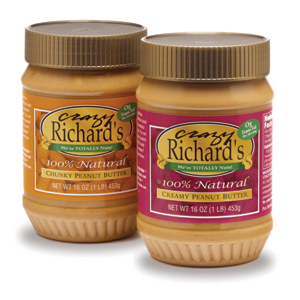
A staple of most kitchens, it is also extremely overlooked as an important food. We all think of peanut butter as a sandwich spread to be partnered with jelly, usually Concord grape jelly.
Oh, but peanut butter is so much more.
It is one of nature’s most perfect foods. High in protein, high in the good kind of fats we all need some of in our bodies to stoke the furnace, filling, tasty, and in ingredient in so many more recipes than the simple PB&J sandwich.
But what peanut butter are you using? What’s in it? When was the last time you read the label on your peanut-butter jar? Are you buying all natural? Do you know what that even means?
Let’s talk peanut butter.
How many ingredients does the peanut butter in your cupboard contain? Two? Three? Four? More? Even the products that call themselves “all natural” contain at least two or three. Why? Usually to make them taste better. Salt? Sugar? Honey? What else? Emulsifiers? Know what that’s all about? So that you don’t have to deal with the oil at the top of the jar.
Did you know that the majority of peanut-butter buyers won’t buy a jar of peanut butter that has oil on the top. “Who wants all that oil?” I’ve been asked. “I don’t want all that oil in my peanut butter, and I certainly don’t want to stir the jar. Too much trouble. Hey! It’s only peanut butter.”
Really?
What about that oil? Comes from the peanuts. It’s a natural part of the peanuts. It’s not added later (of course, in some cheap products, it IS !). It’s just a little bit, and it’s in the peanuts, and it’s a healthy fat. Get used to it.
Too much trouble to stir? C’mon. Really?
I’ll even give you tips for that.
But here’s the deal. There’s only one peanut butter to live in our cupboard. Only one.
Crazy Richard’s.
Smooth or crunchy, certain people in our family like only one or the other. But still, it’s only Crazy Richards in our house.
Want to know why? Read the label. One ingredient. Only one.
Peanuts.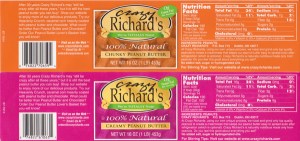
What else does peanut butter need? Salt? Sugar? Honey? None of the above, and none of those ingredients ever find their way into our peanut butter. We buy the only product I’ve found that contains nothing but peanuts.
Crazy Richards.
And if you live in the Midwest, it’s Krema. Same product, different name.
There is no other.
Crazy Richards. Available at Giant here in Lancaster, other stores in other places, and on their web site, http://www.kremaproducts.com/Crazy-Richards-Peanut-Butter/products/1/.
I won’t get crazy with the details about Crazy Richard’s versus other brands; I’ll leave that to you. But suffice it to say, if you want the real deal, it’s got to be Crazy Richard’s. Just peanuts. Nuttin’ else!
So what do you do with peanut butter? Here’s a few ideas beyond the simple peanut butter sandwich:
I call this first dish “Vicki’s Noodles” because I got the recipe from an old friend named, Vicki, a nurse and confessed Jersey Girl I knew many years ago. She could cook, and was especially adept at Asian cuisine. I have several of her recipes in my notebook. This one is Cold Sesame Noodles. The ingredients beyond the sauce are completely optional. I like to use fresh, crispy bean sprouts. A chef I once worked with suggested I add red cabbage and some shredded carrot for color and texture. I liked the way that worked out, and I have also variously included chopped snow peas or sugar-snap peas, which we grow in our garden. You can also give it a note of Thai by adding some fresh chopped basil and maybe a touch of fish sauce. If you like meat in your salad, add grilled slices of chicken, or try it with cubes of premium dry tofu. Play with this one and see what you like. There’s almost no ingredient you could add that would not make it better. The sauce is a nice sweet and tangy one, but it doesn’t get in the way of any kind of additional ingredient.
As for the noodles, I make it with whole wheat linguine, but it is just as good with Asian buckwheat noodles, rice noodles, plain spaghetti, or whatever pasta you prefer. Adjust the heat to your own liking. This one is not too spicy. To kick it up, increase the hot chile oil to 1 tablespoon instead of a teaspoon.
Ingredients:
1 lb. noodles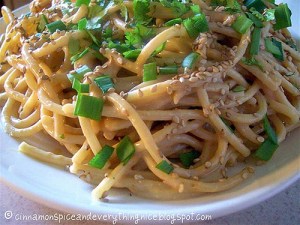
3 Tbsp Crazy Richard’s smooth peanut butter
3 Tbsp rice wine vinegar
3 Tbsp brown sugar
3 Tbsp soy sauce
3 tsp dark sesame oil
1 tsp red chili oil
1/2 cup chopped peanuts
¼ finely-chopped small red cabbage
1 finely grated carrot
1 handful FRESH (!) bean sprouts
1/3 cup chopped scallions (just the green tops)
Procedure:
Prepare the noodles al-dente’ per the package. Cool under warm, then cold running water, coat with 2 tsp sesame oil, set aside.
In a small bowl, combine the next six ingredients (peanut butter through chile oil) with a whisk until smooth and completely blended. Set aside at room temperature.
One half hour before serving, combine noodles with the tofu, peanuts, cabbage, bean sprouts, and half the scallions. Add the peanut sauce and toss to coat all the ingredients with sauce. Allow to rest for a half hour, sprinkle the rest of the scallions over the noodles, then serve (don’t allow this to sit too long. The sauce will eventually break.)
Both the noodles and the sauce can be made ahead of time, but not overnight. They should not be refrigerated. This dish is meant to be served at room temperature. If you plan to add chicken, it should be grilled ahead of time and chilled.
Here’s a very special recipe that absolutely hits the spot on a chilly winter evening. We’ve made this wonderful soup a number of times, and it always surprises. Warms the soul.
Ingredients:

2 tablespoons olive oil
2 medium onions, chopped
2 large red bell peppers, chopped
4 cloves garlic, minced
1 28-ounce can crushed tomatoes, with liquid
8 cups vegetable broth
1 teaspoon kosher salt
¼ teaspoon white pepper
¼ teaspoon chili powder
¼ teaspoon Cayenne pepper (optional)
2/3 cup Crazy Richard’s crunchy peanut butter
chopped peanuts
chopped cilantro
½ cup uncooked brown rice
Preparation:
- Heat the oil in a large soup pot over medium heat. Cook onions and peppers until lightly browned. Add garlic and stir for 30 seconds, but don’t allow to burn. Add tomatoes, stock, salt, and spices and mix well. Reduce heat to low and simmer, uncovered for 30 minutes.
- Stir in the brown rice, cover and simmer another 30 minutes, or until the rice is tender. Stir in the peanut butter until well blended.Garnish with chopped peanuts and chopped cilantro. Serve immediately with warm, crusty bread.
* * *
And last but not least, here’s a terrific recipe for grilled satay, one of my favorite grilled dishes, wonderful as an appetizer, as part of a tapas presentation, or as a stand-alone entree served with Pad Thai or apple-cilantro slaw,  which I’ll present next time.
Ingredients:
- 8-12 skinless chicken thighs or beef top-round cut into 1/4-inch strips
- 1 package wooden skewers
- SATAY MARINADE:
- 1/4 cup minced fresh lemongrass
- 2 shallots OR 1 small onion, sliced
- 3 cloves garlic
- 1-2 fresh red chilies, sliced, OR 1/2 tsp. to 1 tsp. cayenne pepper, to taste
- 1 thumb-size piece galangal OR ginger, thinly sliced
- 1 tsp. minced fresh turmeric OR 1/2 tsp. dried turmeric
- 2 Tbsp. ground coriander
- 2 tsp. cumin
- 3 Tbsp. dark soy sauce (available at Asian food stores)
- 4 Tbsp. fish sauce
- 5-6 Tbsp. brown sugar
- 2 Tbsp. vegetable oil
Peanut Sauce
- 1 cup fresh-tasting dry roasted peanuts, unsalted or 1/2 cup Crazy Richard’s crunchy peanut butter
- 1/3 cup water
- 1-2 cloves garlic, minced
- 1/2 tsp. dark soy sauce
- 2 tsp. sesame oil
- 2 Tbsp. brown sugar
- 1 to 2 Tbsp. fish sauce, depending on desired saltiness/flavor – Vegetarians substitute 1.5 -2.5 Tbsp. regular soy sauce
- 1/2 tsp tamarind paste OR 1/2 Tbsp. lime juice
- 1/2 tsp. cayenne pepper, OR 1 tsp. Thai chili sauce (more or less to taste)
- 1/3 cup coconut milk
Preparation:
For the meat:
- If using wooden skewers, soak them in water while you prepare the meat (to prevent burning). The kitchen sink works well for this.
- Cut the meat into thin strips and place in a bowl.
- Place all marinade ingredients in a food processor or chopper. Process well.
- Taste-test the marinade – you will taste sweet, spicy, and salty. The strongest tastes should be SWEET and SALTY in order for the finished satay to taste its best. Add more sugar or more fish sauce (in place of salt) to adjust the taste. You can also add more chili if you want it spicier.
- Pour the marinade over the meat and stir well to combine. Allow at least 1 hour for marinating, or longer (up to 24 hours).
- When ready to cook, thread meat onto the skewers. Tip: Fill up to 3/4 of the skewer, leaving the lower half empty so that the person grilling has a “handle” to easily turn the satay during cooking.
- Grill the satay on your BBQ, OR on an indoor grill, basting the first time you time it with a little of the leftover marinade from the bottom of the bowl. OR you can broil in the oven on a broiling pan or baking sheet with the oven set to “broil” Place satay close beneath the heating element and turn the meat every 5 minutes until cooked (be sure to soak your wooden satay sticks in water before skewering). Depending on how thin your meat is, the satay should cook in 10 to 20 minutes.
- Serve with Jasmine rice and the Satay Peanut dipping sauce:
For the sauce:
- Place all ingredients in a blender or food processor. Blend or process until sauce is smooth. If you prefer a runnier peanut sauce, add a little more water or coconut milk.
- Do a taste test, adding more fish sauce (or soy sauce) if not salty enough, or more cayenne if not spicy enough. If too salty, add a squeeze of fresh lime juice. If you’d prefer it sweeter, add a little more sugar.
- Serve warm or at room temperature with any Satay meat dish, and it also makes a great dip with fresh veggies, fresh rolls, or other Asian finger foods. Or combine with noodles to create a Thai-style noodle dish or cold noodle salad. Enjoy!
Cheffzilla’s Gazpacho With a Kick
Ingredients:
1 1/2 pounds vine-ripened Roma tomatoes, peeled, seeded and quartered
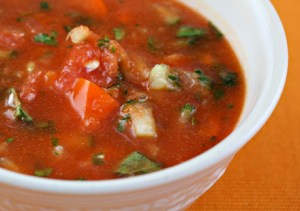
Bottled non-alcoholic Bloody Mary mix (like Mr. & Mrs. T’s)
1 1/2 cup chopped red bell pepper, divided
1/2 cup chopped red onion
1 small jalapeno, seeded, ribs removed, and minced
2-4 medium garlic cloves, minced
1/4 cup extra-virgin olive oil
1 lime, juiced
2 teaspoons balsamic vinegar
2 teaspoons Worcestershire sauce
1/2 teaspoon ground cumin
1 teaspoon kosher salt
1/2 teaspoon freshly ground black pepper
2 tablespoons fresh basil leaves, chiffonadePreparation:
Place the tomatoes and juice into a large mixing bowl. Add the 1 cup cucumber, 1/2 cup bell pepper, red onion, jalapeno, garlic clove, olive oil, lime juice, balsamic vinegar, Worcestershire, cumin, salt and pepper and stir to combine. Transfer 1 1/2 cups of the mixture and the soaked bread to a blender and puree for 15 to 20 seconds on high speed. Return the pureed mixture to the bowl and stir to combine. Cover and chill for 2 hours and up to overnight. Garnish with with chiffonade of basil, serve with bowls of the remaining cucumber and bell pepper, a black-pepper grinder, and a bottle of red pepper sauce such as Tabasco or Sriracha.
The recipe doubles extremely well.
Serves 4
Half-Sours — Serious Deli-style Kosher Dill Pickles
Ever been to a real deli? Like the Stage in New York. Hymies or Murray’s in the Philly ‘burbs. Wolfies at 26th and Collins in Miami Beach. Not to sound too chauvenistic, there are great kosher delis in most large American cities on the east coast, and probably in the near Midwest (Cleveland, Baltimore, Boston…). I used to absolutely love Jack and Marion’s in Boston and the Fairlawn Deli in Akron. I know you have one. We even have Mort’s Delicatessen here in Lancaster, and it’s not bad. Andy at Mort’s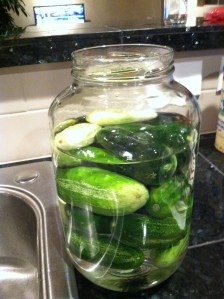 grew up on Hymie’s Merion Delicatessen so his roots are legitimate. He’s created a pretty good place.
Then, and only then, do you know what a real pickle tastes like.
There are pickles in jars out there that are acceptable as deli pickles, but they just don’t approximate the taste (or the experience) of pulling a pickle out of a wooden barrel and eating it then and there.
Real deli pickles are fermented in the brine in large barrels with lots of garlic and pickling spices and dill (never, EVER vinegar). I used to grab a pickle from the Epicure’s barrel on the way into work, just to start my day. Nothing like garlic for breakfast!
But then, I grew up on half-sour deli pickles. My mom made them in the kitchen–always had a big jarful in the fridge at the ready. They never got fully pickled, the way store-bought pickles are. They were only ever half done; ergo “half-sour.” That’s the way we always got them at the deli. The day after the barrel arrived was the best time to get them. They’d get softer and softer the longer they sat, but we really liked them best when they still resembled cucumbers and had a lot of the crunch.
Some of you prefer the full-done kosher dills, and that’s okay too. You can make them yourself and get them done right to where you like them.
The secret to my mother’s approach–and most really good deli pickles–is fresh cucumbers. She’d only make them when she could get fresh pickles from the farmer’s market. She never got her pickle cucumbers at the grocery store. They’ve GOT to be fresh-picked to be right. Fortunately, here in Lancaster we can get fresh Kirby cucumbers in the summer. Thanks to John and Ethel Stoner for that.
So here’s the pickle deal:
Get a clear glass gallon jar with a wide mouth. You could use a plastic jar, but they are rarely clear, so it’s hard to watch the pickles–that’s how you know when they’re ready. It’s a sight thing. Have a hank of cheesecloth–enough to cover the mouth of the jar with two or three layers–and some string or rubber band to secure the cheesecloth. Now you’re ready to begin.
Get enough large Kirby cucumbers to fill the jar, so that they’re packed pretty tight. I can’t tell you how much or how many–it depends on the size of the cukes. Bigger is better, and get enough. Better to have too many. They’re good eating as cucumbers, too.
Other ingredients to have on hand:
- Diamond Crystal kosher salt. I’m pretty specific on this brand, but Morton’s kosher salt will do in a pinch. Don’t use table salt.
- Fresh garlic cloves. I use six to eight cloves, depending on their size. I like mine garlicky. Use anywhere from two to ten.
- A bunch of fresh dill.
- 3 bay leaves
- 3-4 dried red hot peppers (the kind you can get at an Asian market) or dried red pepper flakes
- Mustard seeds
- Coriander seeds
- Whole black peppercorns
How to do this:
Sterilize the jar: fill it full of boiling water, allow the jar to sit 30 minutes filled with the boiling water, then empty the jar, allow it to cool naturally. While it’s cooling, wash your hands with antibacterial soap and rinse well.
While the jar is cooling, wash the pickles well. But don’t scrub them; rub them down with your hands under cold running water. Rinse well, place them in a large bowl and run cold water over the bowl for 10 minutes. DO NOT SKIP THIS STEP!!! This is a good time to eliminate any soft cucumbers. Make sure you use only the firm ones. And nip off the ends of each cuke; just a little nip–this will help keep the pickles crisper longer.
Place two sprigs of the dill in the bottom of the jar; smash two to four of the garlic cloves (leave the skins on) and place them on the dill. Pack the cukes tightly into the jar, being careful not to bruise them. But a tight pack is crucial. When the jar is half full, add two or more smashed garlic cloves, a tablespoon each of mustard and coriander seeds, peppercorns, three bay leaves broken into pieces, three or four dried red peppers (or a teaspoon of red pepper flakes), then fill the jar with more cucumbers until the jar is just about full. Pack them tight.
Then mix two quarts of cold water with four tablespoons kosher salt. Mix well to dissolve all the salt. Pour the water over the cukes until the jar is full. Do it in the kitchen sink. The cukes will want to float. Keep pushing them down while you fill the jar with water. Maybe even try to get one more cucumber in the jar.
Place the remaining garlic (smashed, of course) and then the dill on top. It’s vital to keep the cucumbers completely submerged. Make sure there is enough dill at the top of the jar to hold the cukes under water. Reserve the remaining salt water in a jar in the fridge.
Cover the jar with cheesecloth and wrap it around the sides of the jar top. Tie it in place so that it is tight on top of the open jar mouth. Set on the counter away from direct sunlight and allow to ferment, adding a bit more brine if necessary to keep the pickles under water. After three days, the pickles should be half sour and ready to taste. If there is foam on top of the jar, scoop it off, refill the jar with a little more salt water. If there is foam under the dill, remove and rinse it, and reposition it before adding more brine.
After three days, place the jar in the refrigerator. The pickles will continue to “cook” in the fridge, but the process will slow down considerably under refrigeration. You can keep them on the counter, but they will be full sour pickles in about a week. That may be okay too, but I love mine half sour.
Enjoy real homemade half-sour (or whole-sour) pickles right at home.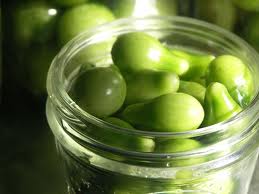
Oh, and by the way, this works really well using firm green unripe Roma tomatoes, too. Pickled green tomatoes are a really wonderful treat.
What??? Living in Lancaster Ain’t Chopped Liver
I had a request.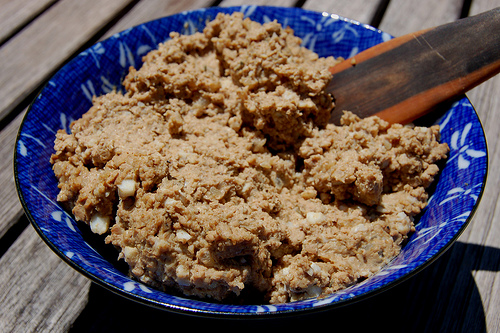
I’m honoring it, with one of my favorite recipes of all time. I made it at the Epicure in Miami Beach, usually 120 pounds a week. They sell a lot of chopped liver in Miami Beach–at least they did when I was there. Of course, Miami Beach wasn’t then what it is now; it was full of people who ate chopped liver and died young (young in Miami Beach back then was defined as 88). But we made chopped liver. Legend had it it was my grandmother’s recipe. I can’t say for sure; she never made it for me, and my father used to say that the rumors of her cooking skills were greatly exaggerated. She was, after all, a working woman from the time she arrived in the US at Providence, R.I. back at the turn of the twentieth century until she had her first heart attack at the age of sixty-something. Grandma Jenny was the greatest. Big, full of life, typical of the American Jewish grandmother but with none of the passive-aggressiveness. Nothing passive about Jenny. Her aggressiveness was right there in your face. Ask Uncle Sidney. But she was very kind.
But a cook? I think not so much. But she used to make me a mean saucer full of hot water with lemon.
Anyway here’s our chopped liver recipe, scaled down from the 120-pound recipe to a more manageable quantity. You might think this is a lot of chopped liver–who needs this much anyway??–but resist the temptation to halve the recipe. This will lose almost half its weight in water during the cooking process. Make at least this much, maybe even double it. This recipe will serve six nicely as an appetizer.
Jenny’s (?) Chopped Liver
Ingredients:
2 pounds fresh chicken livers
2 pounds sweet Vidalia (or large yellow) onions, halved, then thinly sliced
2 tablespoons sweet paprika
1/2 cup plus two tablespoons rendered chicken fat* (see note below)
8 hard-cooked eggs
2 teaspoons kosher salt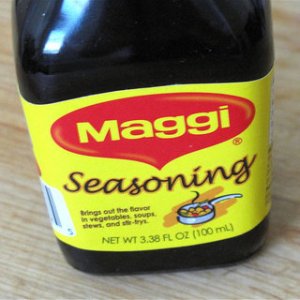
1/2 teaspoon fine-ground white pepper
2 tablespoons honey
2 tablespoons Maggi Seasoning (available at many good specialty grocery stores, and at my local Asian market)
Preparation:
Heat 1/4 cup chicken fat or vegetable shortening until shimmering in each of two large saute pans. Don’t go short here. Hey! This ain’t health food!
In one pan place the chicken livers and saute at medium heat until there is no more pink in the middle and they just begin to crisp up. A little crispiness in the liver is good. A lot is bad Be careful here.. Drain and cool to room temperature in a colander over the sink.
In the other pan saute the onions with paprika, salt, and pepper, over medium-low heat until they caramelize. Cook them slowly–don’t let them burn. Caramelizing onions is a skill a cook needs to learn, then use often. It takes patience. Patience is extremely important. Real caramelized onions are one of the world’s finest treats; they get so sweet you could die. Use them here. After they are caramelized, set them aside to cool completely. Don’t rush this process. The onions and livers need to be completely cooled to room temperature or the final product will be mushy. And nobody likes mushy chopped liver!
When cooled, mix the onions and livers in a bowl, tossing them with your hands to mix well. Use your hands. That’s the way real cooks cook. Then cut the eggs in half and toss them in with the rest of the mess and toss well to combine.
Then run the whole mess through a food grinder attachment to a stand mixer using the largest holes. Alternately, chop the mess up with a pastry cutter in a wooden bowl, but don’t cut the stuff up too fine. There really needs to be a bit of bite to the finished product. This isn’t pate.
Add the honey and Maggi seasoning and mix well. If the chopped liver is too dry, melt the remaining two tablespoons of fat and add it to the bowl a little at a time and mix until it reaches the consistency of tight peanut butter. Just don’t overmix here. You don’t want to chop the stuff up more in the mixing process.
Taste as you mix, adding a bit more salt and white pepper if necessary. Use just a bit more white pepper than you think you need. Chopped liver is soooo much better when it’s just slightly peppery (resist the temptation to use black pepper. It’s the wrong product. Fine-ground white pepper here, please. It should be a staple condiment in your kitchen.
Finally, coat a serving dish with a wee bit of the chicken fat or shortening and put the finished product in the bowl and chill in the fridge for at least six hours. It will be really tempting to eat it all freshly made, but don’t. Let it set up in fridge for a while. It gets better.

Serve the chopped liver with toasted bagel chips, available in bags at the deli counter at most grocery stores. It’s the best way. You’ll thank me later. Melba toast rounds or cocktail rye or pump slices are okay too, but not nearly as good. If you use rye or pump slices, toast them lightly before serving.
* To render chicken fat, place 1 cup raw chicken fat, 1/2 tsp kosher salt and (optionally) half a thinly sliced small onion in a heavy-bottom pot over medium heat, stirring occasionally, until the fat is liquified and the cracklings are golden brown. Strain over a Mason jar, toss the solids, cover and refrigerate until you need it.
Mexican Cold Bean Salad
Talking Fresh
Talking Fresh has taken a left turn. I hope you will stay with me, because I find this new phase of the column liberating.
A bit of history:
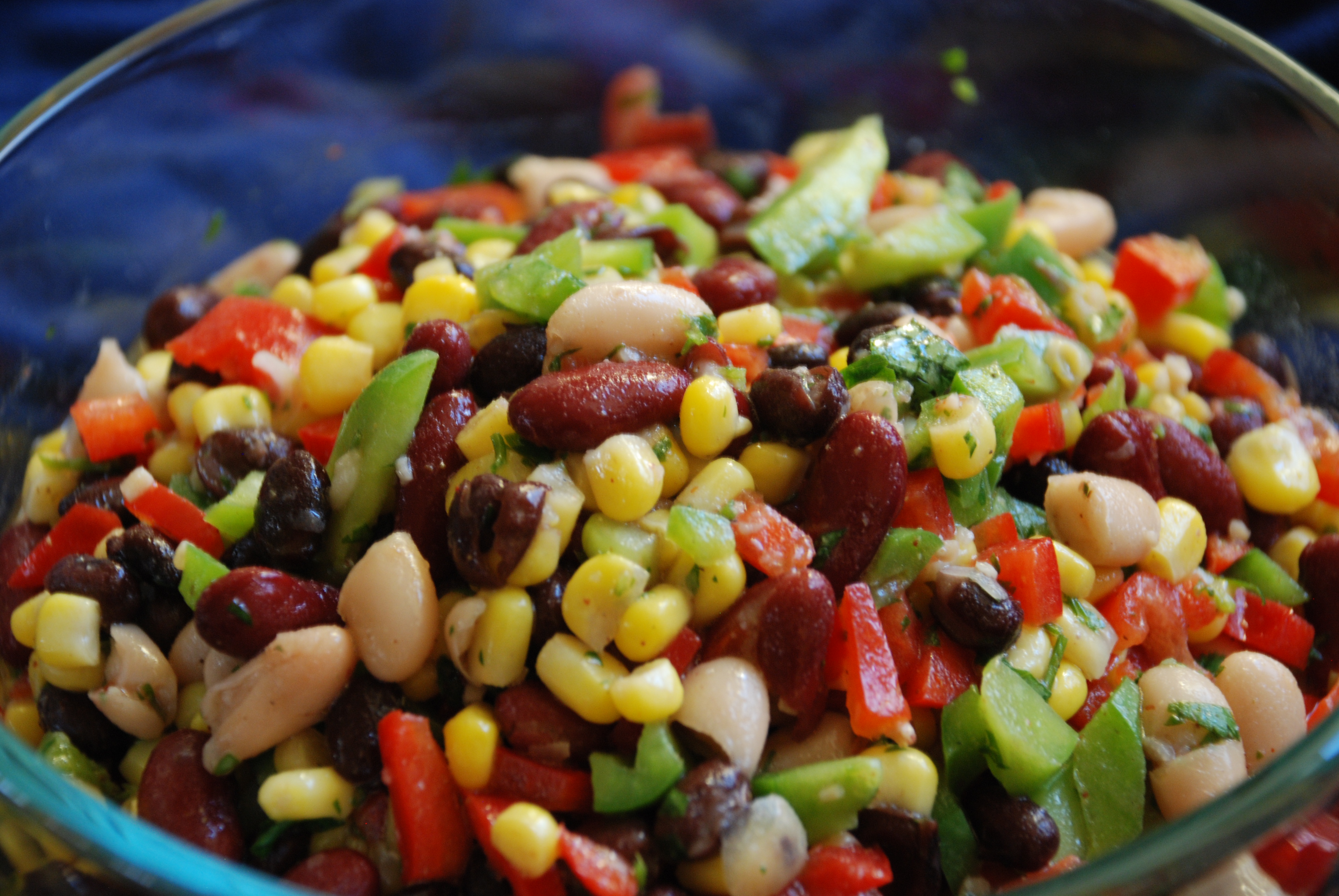
Make this as spicy (or not spicy) as you wish. Add more Tabasco sauce, jalapeno peppers, whatever–or not!
Talking Fresh came about as the result of a conversation I had at church one Sunday morning with Jen Kopf, one of the editors at the erstwhile “Lifestyle” section of the Lancaster Sunday News. I admire Jen and her remarkable writing, her sense of the history and culture of Lancaster, and her obvious love for Lancaster. I asked her why the paper didn’t have a restaurant critic, and if they would be interested in entertaining the idea. I pointed her toward my blog so that she could get a sense of my writing, my style, my sensibility, and my slight leaning toward anarchy (I should point out that before I gave her the URL, I had to clean it up a bit—I’d been blogging for a couple of years at that point, and I tend to write in frenetic bursts, thinking that everything I write is just what everyone else wants to read—my bad!).
A few weeks later Jen got back to me with several reasons why the paper didn’t think a restaurant critic was on their radar, and admittedly, the reasons were sound. But she liked what she read on the blog—she actually used the word “interesting.” I was ecstatic. But not yet a published writer here in Lancaster.
A couple months later I got an email from another editor at Lifestyle, Lynn Schmidt Miller, who suggested that they might be interested in running a semi-weekly column if I could present it just as I present entries in the blog.
“Why sure I can,” I responded. Ulp. Suddenly I’m a food writer in Lancaster, with you all and the rest of the county as my readers, and I owe a column every other week.
No matter what.
With photos.
Of stuff I made myself.
Ulp!
But I took up the challenge, went in to the offices of the paper on King Street, got a photo taken of my former fat self, balloon chin and all, and suddenly I’m a columnist in Lancaster.
In the same newspaper as Gil Smart and Louis Butcher and Larry Alexander and Jeff Hawkes and Tom Murse and all the other fabulous writers we are blessed with in this town.
Ulp.
For me, because Lynn asked me to write the column just as I had been writing my blog, I took that to mean that I was wanted as much for my writing as for my recipes. The truth is, I always considered the blog—and now the column—as an outlet for my writing, and the recipes were simply the device to get people to read the entries. To this day, I don’t know, and don’t really care, whether they were more interested in the writing or the recipes.
Being on a word count made it all the more challenging, but for me it was always about the essay up front. My wife always reminded me that the column had to be about something.
“What’s it about?” she always asked.
When space was tight and the columns got edited, it was always the writing that got snipped, which made me feel a little sad. But I understood—still do—the demands of space in the paper, and half a recipe is worthless.
Which brings me back full circle to this column, which is that I now feel liberated, because the restriction of word counts is off, and now my only task is to be interesting and produce wonderful food and recipes. If I bore you half way down the column, that’s on me.
But I’ll continue to write the column, and continue to love doing it, and hope you continue to read it and to share it with your friends—Facebook and otherwise—so that maybe I can gather some steam for the column and gain some readership.
Here’s hoping.
As I’m writing this, I munching on one of my all-time summer favorites, a Mexican Bean salad Ellen conjured up from her little tin recipe box about which I’ve written more than once. This salad is a killer. It’s cool and spicy and flavorful and filling and simple and festive and…for now I’ve run out of adjectives, but suffice it to say make it, and it will become one of your go-to summer dishes. Lots of ingredients, but lots of flavor. It’ll win raves!
Mexican Bean Salad
- Make this as spicy (or not spicy) as you wish. Add more Tabasco sauce, jalapeno peppers, whatever–or not!
Ingredients:
1 15-oz can black beans
1 15-oz can red kidney beans
1 15-oz can cannellini (white) beans
1 green bell pepper, cored, seeded, ribs removed, and diced
1 red bell pepper, cored, seeded, ribs removed, and diced
1 yellow bell pepper, cored, seeded, ribs removed, and diced
1 medium spicy yellow banana pepper, cored, seeded, ribs removed, and diced
2 ears of corn, lightly steamed, cut from the cob
or
1 10-oz package frozen corn, defrosted
1 red onion, diced
2-3 scallions, white and light green parts only, 1/2-inch chop
½ cup extra-virgin olive oil
½ cup red wine vinegar
2 tablespoons freshly squeezed lemon juice
2 tablespoons freshly squeezed lime juice
1 tablespoons white sugar
2 cloves finely minced garlic cloves
¼ cup chopped fresh cilantro
½ tablespoon ground cumin
½ teaspoon freshly ground black pepper
1 dash (or more—wayyyyy more) red pepper (read: Tabasco) sauce
1 teaspoon chili powder
Preparation:
In a large bowl, combine beans, peppers, corn, and red onion.
In a small food chopper, add all remaining ingredients and pulse until they are well mixed. Pour dressing over salad fixin’s and toss well to coat. Chill thoroughly and serve cold.
Serves 8
- Make this as spicy (or not spicy) as you wish. Add more Tabasco sauce, jalapeno peppers, whatever–or not!
French Lentil and Swiss Chard Risotto
Okay, so the Sunday News won’t be carrying my column anymore, but that doesn’t mean you can’t access my kitchen. I plan to continue writing Talking Fresh, and hope all of you Facebook friends will Like Jeff’s Kitchen here, and share my posts with your friends, and encourage them to like my page as well. It takes a village, and all those six degrees and such can turn this into a movement, if you’re willing.
That said, I’m also going to put up a post on opposite Sundays featuring what I get in my CSA bag from Caitlin and EmmaKate at Blue Rock farm. Today I got lettuce, mustard and beet greens, beets, fresh dill, a perfect head of garlic, one yellow squash, snow peas and mixed (pole or bush?) beans, and chard.
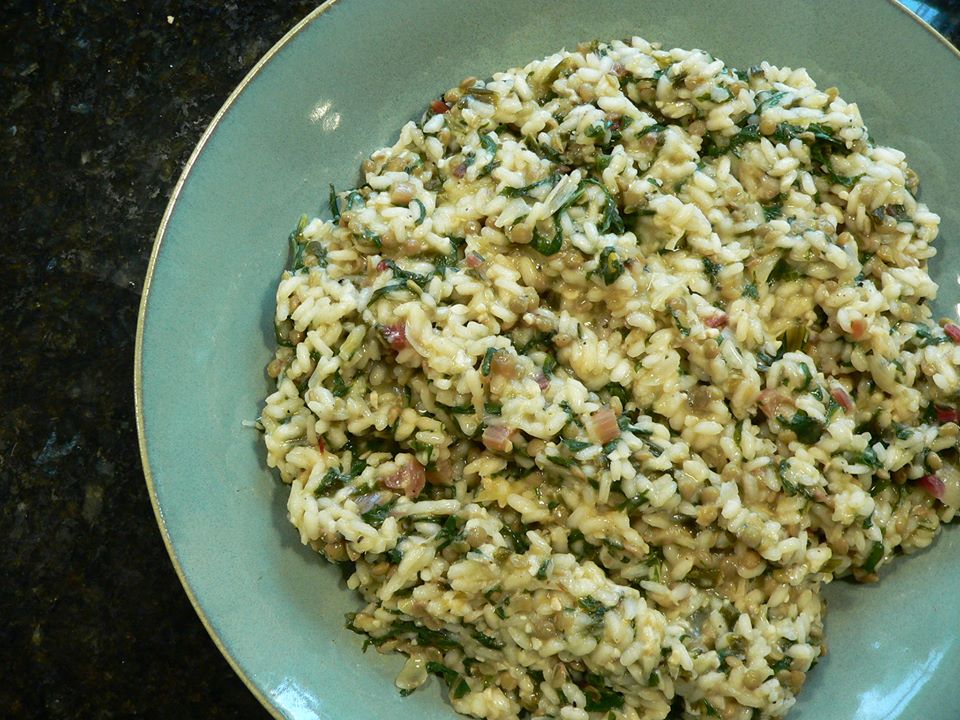
Here’s what I’ll be making for supper tonight, all the fresh ingredients coming from the young women’s wonderful little farm in Willow Street, PA.
Thanks indeed to Martha Stewart for the inspiration for this recipe. I’ve altered it a bit from her original to make it my own, and to feature the fine ladies of Blue Rock Farm. By the way, it is wonderful cold, and reheats beautifully.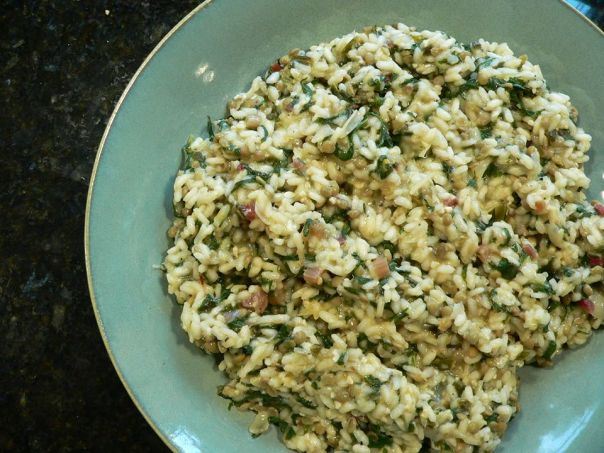
Please enjoy responsibly.
French Lentil and Swiss Chard Risotto
Ingredients:
1 bay leaf
6 sprigs fresh thyme plus 2 teaspoons leaves
1/3 cup French green lentils
1 bunch Swiss chard
1 cup finely chopped onion and the onion greens
4 cups low-sodium chicken stock
1 tablespoon olive oil
1 ½ teaspoons minced garlic
1 ¼ cups Arborio rice
½ cup dry white wine
1 teaspoon kosher salt
¼ cup freshly ground white pepper
¼ cup freshly grated Parmesan cheese
1/3 cup freshly shredded chard or beet greens, for garnish
Preparation:
1. In a medium saucepan, combine 6 cups water, bay leaf, and thyme sprigs and bring to a boil. Simmer for 5 minutes; add lentils, reduce heat to low and simmer until tender, about 20 minutes. Drain lentils and set aside; discard the rest.
2. Wash chard and remove stalks; slice leaves into very thin 2-inch strips, and dice the smaller stems into ¼-inch dice. Discard the larger stems. Sauté with a bit of olive oil in a large skillet, tossing constantly over high heat until just wilted; set aside in a colander.
3. Finely chop the onions and slice the greens into ½-inch rings.
4. Bring the stock to a boil, reduce the heat to low, and keep at a bare simmer.
5. Heat olive oil in a large heavy pot over medium heat. Add onion, onion greens, and garlic and cook, stirring frequently until soft but not browned, about 6 minutes. Add rice and thyme leaves and continue stirring until the edges of the rice become translucent, 3-4 minutes. Add the wine, stirring constantly, until nearly all the wine is absorbed.
6. Raise the heat to medium-high, add the salt and pepper and ½ cup stock and cook, stirring constantly until nearly all the stock is absorbed. Repeat this process, adding ½ cup stock at a time, until the rice is creamy but still a little firm, 15-20 minutes.
7. Remove the pot from the heat, and stir in the lentils, chard, and Parmesan. Season to taste with salt and pepper, plate and serve immediately garnished with the shredded greens.
Serves 6
 Cheffzilla’s Kitchen